Read Your Land, Not Your Calendar: A Grower's Guide to Mapping Frost Patterns for Better Harvest Timing
Every fall, somewhere across the country, a home grower steps outside on a cold morning and finds their nearly-ripe figs blackened and mushy — even though the calendar said they had another two weeks. Meanwhile, a neighbor three streets over is still harvesting kiwi berries well into November. Same zip code. Same forecast. Completely different outcomes.
That gap isn't luck. It's microclimates. And once you understand how to read them, you can stop treating frost dates like a fixed deadline and start treating your property like the layered, dynamic system it actually is.
Why USDA Zones Only Get You So Far
The USDA Plant Hardiness Zone Map is genuinely useful — but it was designed around one specific question: can a perennial plant survive winter in your area? It uses average annual extreme minimum temperatures, not the nuanced frost timing that determines when your fruit gets hit in fall or when you can safely plant in spring.
Average first frost dates, which most growers rely on, are statistical summaries pulled from weather station data. Those stations are usually located at airports, fairgrounds, or municipal buildings — flat, open, often paved areas that behave nothing like a sloped backyard with a windbreak on one side and a concrete retaining wall on the other.
The National Oceanic and Atmospheric Administration (NOAA) publishes historical frost probability data by location, and that's a much better starting point than a single average date. At weather.gov, you can look up the probability of frost occurring on any given date for your area. Knowing there's a 10% chance of frost on October 15th versus a 90% chance tells you something the average date never could.
But even that data is regional. Your actual property is something else entirely.
Cold Air Is a Liquid — Treat It That Way
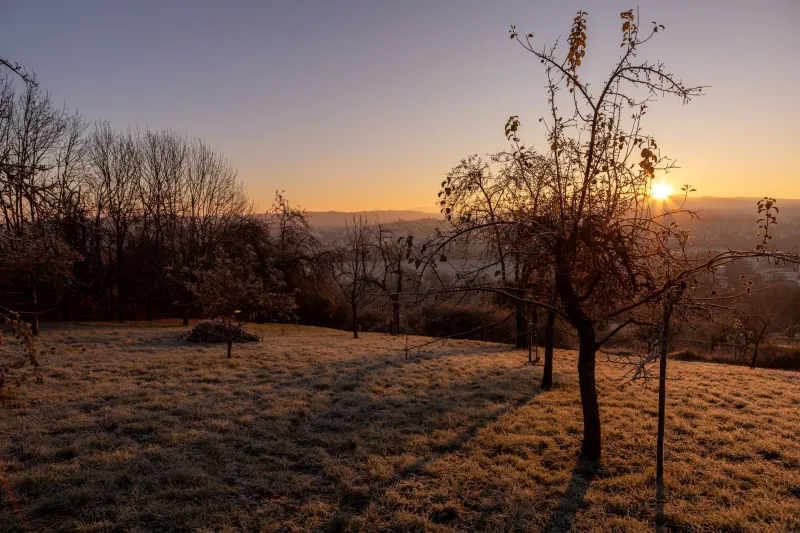
Here's the single most important concept for understanding your frost windows: cold air is dense and flows downhill. On calm, clear nights — the classic radiation frost conditions — cold air drains from higher elevations toward low points, pooling in depressions, hollow areas, and the bottoms of slopes. Gardeners and farmers call these frost pockets, and they can be five to ten degrees colder than a spot just fifty feet away on higher ground.
If your fig tree is planted at the base of a slope or in a low corner near a fence that blocks airflow, it's sitting in a cold pool every clear night. Meanwhile, a tree planted on a gentle rise with open air movement might sail through the same evening unscathed.
South-facing slopes in the Northern Hemisphere absorb more solar radiation during the day and radiate heat back slowly at night, making them naturally warmer microclimates. North-facing slopes do the opposite. Structures like stone walls, brick patios, and concrete foundations absorb daytime heat and release it after dark, creating warm microzones that can push your effective frost date back by a week or more — which is exactly why espaliered figs against a south-facing brick wall have been a European tradition for centuries, and why it works just as well in Virginia or Tennessee.
Mapping Your Property: A Simple Method That Actually Works
You don't need expensive sensors or a meteorology degree. Here's a low-tech approach that gives you surprisingly accurate data.
Get a few min-max thermometers. These are inexpensive thermometers that record the highest and lowest temperature over a period. Place three or four around your property — one in your lowest point, one on a slope or elevated area, one near a heat-absorbing structure, and one in an open central location as your baseline. Check and reset them every morning for two to three weeks during early fall and again in early spring.
Track your soil temperature too. A simple probe thermometer pushed four inches into the ground tells you when soil is holding warmth overnight, which matters a lot for root crops and for understanding why a raised bed or mounded planting area might protect fruit plants longer than flat ground. Soil at 50°F or above acts as a thermal buffer, slowly releasing heat into the surrounding air on cold nights.
Note the conditions. Clear, calm nights produce the worst radiation frosts. Cloudy nights trap heat. Windy nights mix the air column and prevent cold pooling. Once you start connecting your thermometer readings to weather conditions, patterns emerge quickly.
After even one season of this, you'll have a property-specific frost map that no app or USDA chart can give you.
Real Differences Across US Regions
This isn't abstract theory — it plays out in very practical ways depending on where you're growing.
In the Mid-Atlantic and Southeast, fig growers in places like North Carolina or Maryland often find they can push harvest well into October by siting trees against south-facing walls or fences. The challenge is spring frosts catching new growth, so understanding your last frost date with the same precision matters just as much.
In the Pacific Northwest, kiwi growers — particularly those growing the cold-hardy Actinidia arguta varieties — deal with fall frosts arriving while fruit is still sizing up. Knowing that a hillside site in the Willamette Valley might stay frost-free two to three weeks longer than the valley floor is the difference between harvesting ripe fruit and harvesting starch.
In the Upper Midwest, where temperature swings are dramatic, growers of cold-hardy fruits like hardy kiwi and pawpaw rely heavily on microclimate selection because a single bad frost event can wipe out a crop that was days from harvest. Here, windbreaks and proximity to large water bodies (which moderate temperature) are the two most powerful tools available.
In California and the Southwest, the concern often flips — late spring frosts can catch stone fruit blossoms even in mild zones, and low-lying citrus groves face frost risks that hillside plantings escape.
Using Historical Data to Set Your Personal Frost Window
Once you've mapped your property's microclimates, layer in historical probability data from NOAA. Pull up the 30-year climate normals for the nearest weather station, note the dates at which frost probability crosses the 10%, 50%, and 90% thresholds, and then adjust based on what your on-property thermometers have shown you.
If your lowest planting area consistently runs four degrees colder than the regional station, shift all those probability dates two to three days earlier in fall and later in spring. If your south-wall microzone runs six degrees warmer, shift them the other direction.
This gives you a personalized frost window — not a single date, but a range with associated risk levels. You can decide whether a particular fruit or a specific harvest is worth gambling on a 20% frost probability, or whether you'd rather pick early and ripen indoors.
The Payoff: Longer Seasons, Better Fruit
For sensitive fruits like figs, kiwis, and late-ripening persimmons, this kind of precision can realistically add two to four weeks to your effective growing season. That's not a trivial gain — it's the difference between fruit that never fully develops its sugar and fruit that hits true peak ripeness before the cold arrives.
The growers who consistently get the best harvests aren't the ones with the best luck or the most expensive equipment. They're the ones who've taken the time to actually learn their land. A few thermometers, some careful notes, and a season's worth of attention will teach you more about your growing conditions than any app ever will.
Your calendar is a rough estimate. Your property is the truth.