Your Fridge Is Quietly Draining Your Homegrown Fruit of Its Best Nutrients
Here's a thought that might mess with your head a little: that bowl of freshly harvested peaches sitting in your refrigerator right now could be shedding vitamins faster than a commercially packed crate of the same fruit traveling from California to a grocery store shelf in Ohio.
Yeah. It stings a bit.
But before you start questioning every decision you've ever made in your backyard orchard, let's unpack what's actually happening — because the story isn't that home-grown fruit is somehow inferior. It's that most of us are storing it all wrong, and the commercial cold chain has a few tricks we've never bothered to steal.
What the Commercial Cold Chain Actually Gets Right
When people picture commercial fruit storage, they usually imagine something vaguely sinister — massive warehouses, chemical treatments, fruit sitting in limbo for months. And sure, some of that's real. But the part that often gets overlooked is how precisely controlled those environments are.
Large-scale operations use what's called Controlled Atmosphere (CA) storage. This isn't just "keep it cold." It's a carefully managed combination of reduced oxygen levels (sometimes as low as 1-2%), elevated carbon dioxide, specific humidity targets, and temperatures dialed in to within a fraction of a degree. For apples, for example, CA storage can maintain ascorbic acid (vitamin C) levels and polyphenol concentrations for months — genuinely months — because the entire metabolic process inside the fruit has been dramatically slowed down.
The key insight here is that nutrient degradation in fruit isn't just about temperature. It's about cellular respiration. Fruit is still alive after you pick it. It's still burning through its own sugars, enzymes are still active, and oxidative processes are still running. CA storage essentially puts the fruit in a kind of suspended animation by starving those processes of the oxygen they need to keep moving.
Your kitchen refrigerator does none of this.
Why Your Fridge Is the Wrong Tool for the Job
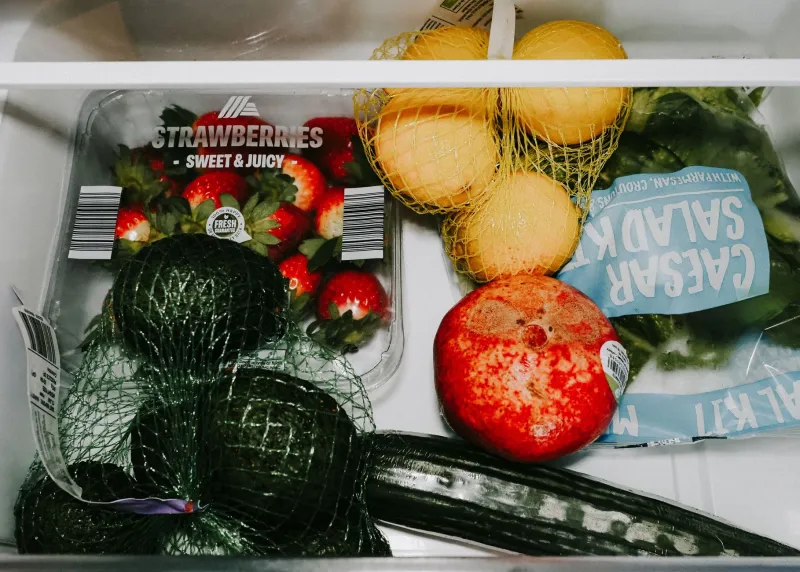
A standard home refrigerator runs at around 35–38°F with humidity that fluctuates every time you open the door, oxygen levels that are completely normal, and ethylene gas — the ripening hormone naturally produced by fruit — accumulating unchecked unless you've deliberately separated your ethylene-sensitive items.
For commercially harvested fruit, which was picked underripe specifically to survive transport and storage, this environment is actually pretty workable. The fruit wasn't at peak metabolic activity when it was picked, so the degradation rate is lower to begin with.
Homegrown fruit is a completely different situation. When you harvest from your own trees or garden beds at true ripeness — which is absolutely when you should be picking — you're grabbing fruit that's at the peak of its metabolic activity. Antioxidant levels, vitamin concentrations, and aromatic compounds are all at their highest. But so is the rate at which those compounds are breaking down.
Put that fruit in a standard fridge and you've slowed things down, sure. But you haven't stopped the process. Vitamin C can degrade by 15–25% within the first 24–48 hours of refrigeration in ripe fruit, depending on the variety. Anthocyanins in berries, which are responsible for a lot of their antioxidant punch, are particularly vulnerable to temperature fluctuations and exposure to light — both things your fridge isn't great at managing consistently.
The Ethylene Problem Nobody Talks About
Ethylene is the silent complicator in all of this. Every piece of ripe fruit in your refrigerator is emitting this gas, and it's accelerating the ripening — and subsequent breakdown — of everything nearby. That bag of blueberries next to your apples? The apples are gassing the blueberries into an early grave, nutritionally speaking.
Commercial storage facilities use ethylene scrubbers to actively remove this gas from the atmosphere. Some home growers have started using small ethylene-absorbing packets in their storage areas, and they're genuinely worth the few dollars they cost if you're serious about post-harvest nutrition.
The bigger issue is that most of us just toss everything into the crisper drawer together and hope for the best. Separating ethylene-producing fruits (apples, pears, peaches, plums) from ethylene-sensitive ones (berries, grapes, citrus) is one of the simplest changes you can make to extend both the life and the nutritional quality of your harvest.
Practical Strategies for Home Growers
So what can you actually do? You're not going to install a CA storage unit in your garage — or maybe you are, in which case, respect — but there are real, accessible ways to close the gap between your fridge and a commercial cold chain.
Harvest in the early morning. Fruit picked before temperatures climb has lower field heat, which means it enters storage in a better state. This one's free and takes zero extra effort.
Pre-cool before refrigerating. If your fruit has been sitting in the sun or in a warm kitchen, don't put it directly into the fridge. Let it cool gradually in a shaded, ventilated spot first. Rapid temperature changes stress the cellular structure of the fruit and accelerate enzyme activity.
Mind your humidity. Most crisper drawers can be adjusted for high or low humidity. Berries do better with lower humidity to prevent mold; stone fruits and apples hold better at higher humidity to prevent moisture loss. Actually use those settings.
Don't wash until you're ready to eat. Water speeds up microbial activity on the surface of fruit and accelerates breakdown. Wash right before consumption, not right after harvest.
Consider short-term alternatives to refrigeration. For fruit you're going to eat within 24 hours, a cool, dark countertop is sometimes better than the fridge. Tomatoes famously suffer in the refrigerator, losing volatile aromatic compounds rapidly, and the same is true for some stone fruits. If you're eating it today, let it breathe.
Freeze for long-term nutrition retention. Here's the real secret weapon: properly frozen fruit — blanched where appropriate, flash-frozen, and stored at 0°F — retains nutrients dramatically better than refrigerated fruit held for more than a day or two. If you've got more harvest than you can eat fresh, the freezer is almost always a better nutritional choice than the fridge.
Rethinking What "Fresh" Actually Means
There's a cultural assumption baked into American food habits that fresh equals best, and refrigeration is how you preserve fresh. But nutritional science doesn't quite work that way. "Fresh" is a snapshot — a moment in time — and what happens to fruit after that moment depends entirely on the conditions you create.
Commercial operations have invested enormous resources into understanding post-harvest science because their business depends on it. As home growers, we tend to think the hard work ends at harvest. But how you handle your fruit in the hours and days after picking has a massive impact on whether all that effort in the soil, the pruning, the irrigation, the pest management — whether any of it actually translates into the nutrition you're hoping to get on your plate.
The good news? You grew that fruit at peak ripeness, which means you started with a nutritional profile that most commercial fruit never reaches in the first place. You're ahead. You just need to stop letting the fridge erase that advantage.